Monday, November 25, 2024

The Alien Diaries Visits Bulgaria Part Two - Offbeat Things About Bulgaria


Life for most of us is full of steep stairs to go up and later, shaky stairs to totter down; and very early in the history of stairs must have come the invention of bannisters.

Louis Kronenberger

Stairs and mural in Veliko Tarnovo

Bulgaria is hilly and mountainous.  The cities were built on hills and access to tourist sites involved climbing up (and down) many stairs, often without bannisters. Good balance is essential, especially on rainy days, when stone steps can be slippery. I don't remember which cities in Bulgaria had the most stairs.  Plovdiv comes in as a close second after Veliko Tarnevo.

The photo below is of an endless stairway, also with no handrails. It took forever to get down. There were times I had to go down sideways.

Going down from one of the Thracian tombs. 

Plovdiv is the place to visit if you love murals.and ruins.

The amphitheater in Plovdiv had some really steep stairs. This particular set had handrails, a modern innovation. The amphitheater is used for concerts and performances during the summer.


No handrails on these stairs, also in Plovdiv.  Like Rome, it is an ancient city (predating Rome) and built on seven hills. The Romans had not installed bannisters when they built this structure. I wonder how many people fell down the stairs......


Check out this manhole cover.  It contains the coat of arms of the city of Plovdiv and to me it's a work of art. The motto translates to: "Ancient and Eternal." I you look close enough you can see the seven hills.   Walking on cobblestones in the Old Town was brutal after a while. Even with supportive sneakers it was hard of my knees.


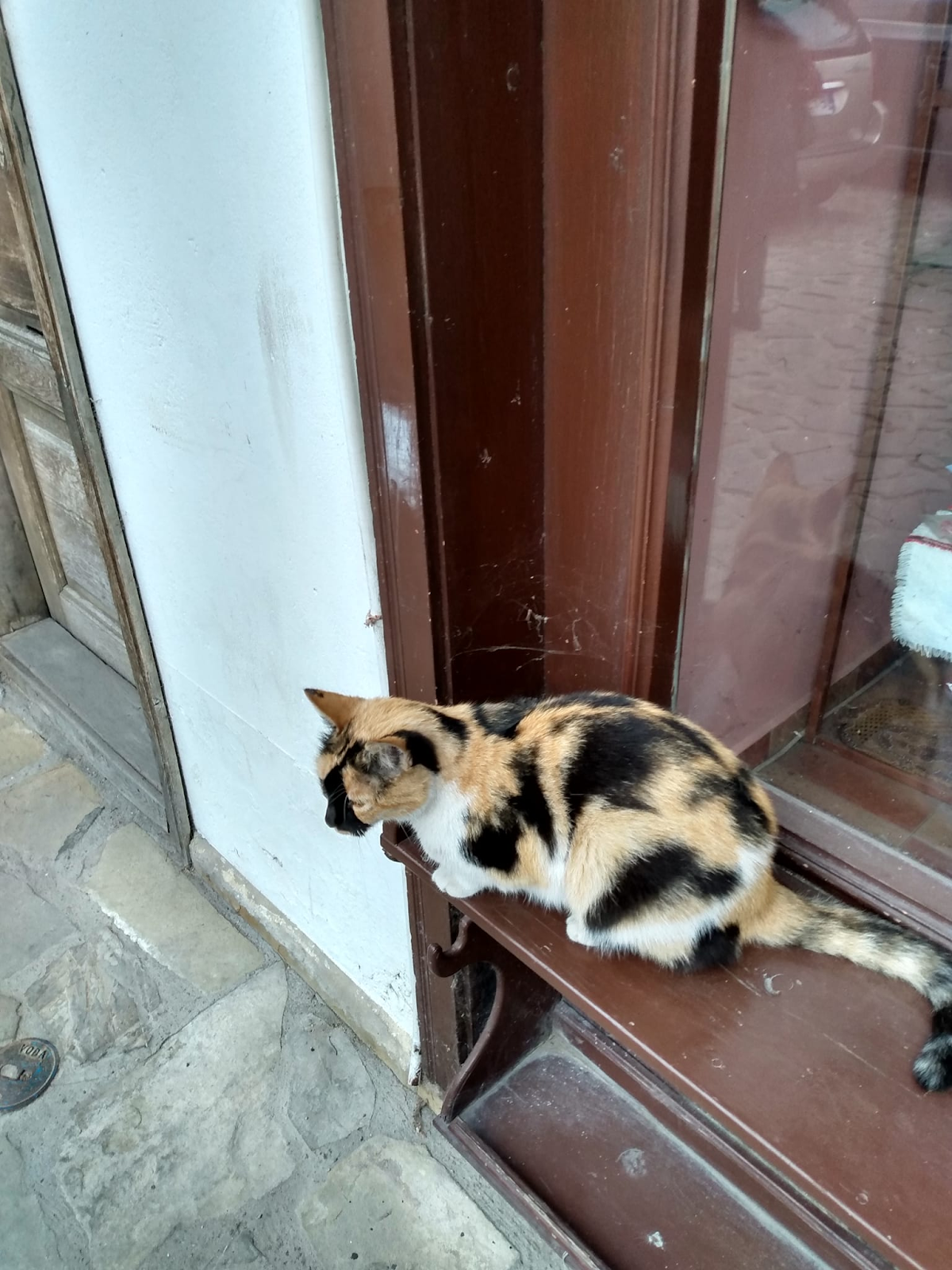
There were street cats everywhere.  I don't know if people owned them but they were used to being around humans.

During patriotic holidays in Bulgaria, the leader of the dance often holds a Bulgarian flag in their hands. I missed the celebration in Plovdiv during the weekend of Unification Day; but this is what a street celebration looks like: (not my video; this was taken in Brussels). This was the celebration of the anniversary of Bulgaria joining the European Union (it has been a part of the EU since 2007).  The EU is headquartered in Brussels. It was a rainy day, but that didn't dampen the enthusiasm of the crowd.

If you want to skip to the dancing start at 1:45. What I like about this video is that a woman leads the dance (Pravo Horo), one of the most popular dances in Bulgaria.


Bulgarians are enthusiastic about their folklore (music and dance); it is a big source of pride and patriotism for them. After being oppressed by the Turks for 500 years, I can understand why. Since many young Bulgarians (and a few older ones) speak English) they chatted with me when I told them of my interest in folklore and we had some lively conversations (more on this in a future post).  They were particularly impressed when I told them I was familiar with many of the dances.

In Bulgaria, especially in Sofia, there are underpasses under the busiest streets. They are a clever way to for people to avoid unwanted encounters with traffic and trams. The metro stations are accessible from the underpasses. Another unique thing about this underpass was that there were exhibitions of the ruins of Serdica.  They were found when the Sofia Metro was under construction.


Bulgarians live forever in the afterlife on trees and bulletin boards in the center of town.  These obituaries are called "necrologs."  I took no pictures of them out of respect for the families, but if you want to see what they look like and read more about them, click here.

If you enjoyed this you may also like:


The Best of the Bisserov Sisters and Family (includes video footage taken in the Sofia Metro at Serdica station).


Friday, November 22, 2024

The Alien Diaries Visits Bulgaria Part One - Common Misconceptions About Bulgaria

Um... Bulgaria is an interesting country. The people are lovely. There are potholes the size of small planets. 
Rachel Nichols 
Photo above taken in Plovdiv 

Regarding the quote above I agree with the author on Bulgaria being an interesting country.  My experience with the country and the people was very positive.  My motivation to visit was connected with history and folklore.  I was not disappointed.

People from the States, in general, know little about Bulgaria.  World history and geography aren't taught much in the schools here.  So it is not a surprise that many people here have misconceptions.

Does Bulgaria have a seacoast?
Where is Bulgaria exactly??
Is the water drinkable? 
Do they use the Russian alphabet?
Do the people live in housing projects?
Are the roads riddled with potholes?

First, let me clear up some of these misconceptions.

A woman I knew years ago who was educated and who also taught a writing class asked me the question about the seacoast.  Bulgaria has a seacoast facing the Black Sea.  It is very popular in summer with foreigners, especially British and Germans, who are sun-starved.  It's (almost always) sunny in Bulgaria from June to September.

People from northern Europe flock to Sunny Beach (near Nessebar).  It is a party town infested with tourists.  Avoid it if you can, it is too commercialized and full of bars and drunks.  Go to Varna instead. The beach was quite nice in mid-September, after most of the tourists left, and the weather still warm.


Varna

The video below is of the craziness that is Sunny Beach:


To verify the location of Bulgaria on the map, go to Wikipedia. See the green object on the map?  That is Bulgaria.  Greece and Turkey form the southern border; North Macedonia is west, Romania and Serbia to the north.

As for the water, the large cities have potable water, I can't speak for the villages where people use well water.  In Dupnitsa, I saw a fountain where people bottled the water and used it for drinking; it was mineral water with healing qualities. The answer to the drinking water question is: yes.  Bulgaria has been an EU country since 2007.  They have to meet certain standards for membership. You can safely drink the tap water in the larger cities, although most people prefer bottled water.


Dupnitsa

The Cyrillic Alphabet, used in most of Eastern Europe (that includes Bulgaria, North Macedonia, Serbia, Ukraine, and Russia) was a descendant of Old Church Slavonic, used by Saints Cyril and Methodius.  They were originally from Thessanoliki (Greece).  The purpose of the alphabet was to teach literacy and religion to the Slavs.  On May 24th, there is a Bulgarian holiday to honor Cyril and Methodius.  

There was an exhibit of Old Church Slavonic side by side with the Bulgarian Cyrillic alphabet in a museum in Sofia:  The saints are in the lower right hand corner.  By the way the Bulgarian alphabet was the precursor to Cyrillic alphabets used in other Eastern European countries, including Russia. 


Ask anyone who has been to a former Eastern Bloc country, and they will mention the apartment blocks.  They look like housing projects in the States, basic, utilitarian housing with very little sense of esthetics.  I grew up in the South Bronx in one of those projects, so Bulgarian apartment buildings had a sense of familiarity about them. 

Bulgaria has a reputation for potholes.  The highways are well maintained, however, some of the back roads in the smaller towns and villages have a pothole problem. The tour bus driver avoided most of them; however some of the back roads in some of the smaller towns and villages were quite bumpy. (This is not a problem unique to Bulgaria, we have them in the United States too).  I live in Massachusetts and the potholes cause major damage to cars during the winter months. I have seen potholes in Massachusetts that can swallow cars!

I don't recommend driving in Bulgaria, but if you plan to (good luck) see link for a pothole map. It is updated periodically.

Part two of this series will be about some cool sights in Bulgarian cities as well as some scary stairs.

If you enjoyed this you may also like:


Thursday, August 8, 2024

The Boris Karlov Birthday Anniversary Post

 Music is the universal language of mankind. 
 Henry Wadsworth Longfellow

 August 11 of this year marks the 100th birthday anniversary of Boris Karlov, folk musician and accordionist. (Please do not confuse him with the British actor Boris Karloff of Dracula movie fame; the name he took is a stage name.  His real name is William Henry Pratt and he wasn't Slavic. Enough said.)

Although Boris Karlov passed on much too soon, 60 years ago, in 1964, his music is played at folk dances today.

After I read the Bulgarian YouTube comments I noticed that he is held in high regard in his home country as one of the best folk musicians.  The people in Serbia are also fond of his music (there is a statue of him in Kraljevo, where he gave his final concert.) He created magic on that accordion.

Boris Karlov was born in Sofia in 1924 to a family of Roma musicians. Video #1 is a tune he wrote about his home town: Sofiisko Shopsko Horo. Shopsko denotes the western region of Bulgaria; the region is known as Shopluk.


Video #2 is another fast tune (Karlov was best known for really fast music).   The dance is named after another Bulgarian city: Vidin.  The name is Vidinsko Horo. The costumed dancers are from Japan (Bulgarian folk music is very popular there).


Video #3 is one of the best known Karlov tunes: Bavno Oro.  Bavno is Bulgarian for slow, but the last 40 seconds or so of the music is fast! (Note: this is a tune from North Macedonia that is  popular in
Bulgaria.)

The music changes from 7/8 to 7/16 very quickly.  See video below.


Most folk dancers will recognize Video #4 as the music for the dance Sedi Donka.  Here it is listed as Plovdivsko Horo (Sedi Donka is a dance from Bulgarian Thrace, where the city of Plovdiv is located.) This is a tune that flies at warp speed. Feet can hardly keep up with this especially since this dance alternates multiple meters: 7/16 and 11/16 (there are slower versions of Sedi Donka but this one is the best).  


Video # 5 is one of my favorite dances and quite challenging so I have included a teaching video by Jim Gold.  It is a fast rachenitsa (rhythm: apple-apple-galloping). Of course Karlov had to play the national dance of Bulgaria (there are several arrangements of rachenitsa by Boris Karlov on YouTube).  This one is  Gjuševska Rachenitsa. If you want to skip the teaching, the dance starts at 4:50)

This is dance named after a town: Gjueševo. The Bulgarians named it after another town: Pazardzhik.   It doesn't matter, this is a great piece of music!


Unfortunately, Boris Karlov died at the age of 40 from kidney failure while on tour in Serbia.  Extensive touring in former Yugoslavia, Austria, and Bulgaria may have contributed to his demise. Who knows what other magical tunes he could have written had he lived longer?  He left quite the legacy despite the brevity of his life on Earth.

If you enjoyed this you may also like:


You can read more about Boris Karlov's life, in Bulgarian, in an article by Nikolai Chapansky, announcer of several folk music programs on Radio Plovdiv

Thursday, November 30, 2023

Dances from Oltenia Part Seven

I do have fun writing, and a long time ago, I told myself, 'You got to have fun at this, or it'll drive you nuts.
Elmore Leonard 

The leader at the Wednesday night Zoom meeting seems to be fond of fast Romanian dances from Oltenia. He does a hybrid session; the local people attend in person; and there's a Zoom option for those who live at a distance.

The dances featured here have one thing in common: they are Alunelul dances from Oltenia in Romania.  They have different music and different choreographies.

There is a little confusion (that word again!) as to how the name Alunelul originated.  One is the Romanian word for  hazelnut. The other is "A lu Nelu" or a dance for John; Nelu being the nickname for John. There are many dances with Alunelul in the name. The ones featured today are not the only ones!

 Video #1 is Alunelul Sucit, done by the Dunav dance group from Jerusalem in Israel. The leader is Yehuda Ben Harush. (The strigaturi in this dance refer to the numbers one to four).  Sucit in Romanian means "twisted or distorted."  The figure than goes into the center looks like a twist. I think it's a twisted dance with counting.  

   
Video #2 is  Alunelul ca la Sadova. Sadova is a village in Dolj county. There are no strigaturi in this dance. Dances are usually named after cities, towns, and regions.

This group is the "Bonding Folkdance Class" from Taiwan.

   
 Video #3 is Alunelul de la Bailesti (a town in southwest Romania).  Balkan dance is very popular in Asia. The language on the website is Chinese.

   
 Video #4: Alunelul de Brau performed at a Romanian festival in Boulder, Colorado, USA.  There are strigaturi in this dance. For some reason they only count to four (patru), but the music is very short; less than two minutes long.


 If you enjoyed this you may also like: Dances from Oltenia Part Six (links to the other posts in the series).

Wednesday, November 8, 2023

Hora de Mina (mână) Variations

Hands have their own language. 
 Simon van Booy

Today's post is about three variations of the dance Hora de Mina (mână). It emphasizes a particular body part, the hands. There are two spellings, one with diacritics and one without. Most groups in the States use the spelling "mina" without diacritics.  

 Video #1 is the version done by nearly every folk dance group. The melody is played on a bagpipe (cimpoi) in Romanian. It's from the region of Oltenia in southwest Romania. The dancers are from Jerusalem in Israel.


Video #2 has different music and different choreography than Video #1. This group, Hora Romaneasca, is from Boulder, Colorado, USA, performing the dance during a festival.  This one has strigaturi (shouts) and a lot of hand movement.


Video #3 is a version of Hora de Mina that I haven't seen before.  This one seems to be more popular across the Pond. 

The dancer, Rosemary Gledhill, is from the United Kingdom. Does anyone out there know the name of the song? This is the only version of this dance with vocals. There is a teaching segment at the end of the video.


Since dancing is much more fun in a group, here is Hora de Mina version 3 performed by Kaval, a group from the Netherlands.  Kaval is also the name of a musical instrument, an end blown flute played in the Balkans.


 If you enjoyed this you may also like: Dances from Oltenia Part Six (links to the previous posts in the series)

Thursday, October 19, 2023

Storm Large Channels Maria Tanase

I look at the artistic process as like experiencing the world, channeling it through your personality and sending it back out there. That's the process. 
David Sanborn 

Earlier this year I wrote a post about Ciuleandra and the world-famous singer Maria Tanase. Her voice and her style were unique. There is one other person who was able to channel Maria Tanase and that is Storm Large. The song is Până când nu te iubeam. The song is based on lyrics by Anton Pann.  Anton Pann was a teacher, student of folklore and a poet in 19th century Romania.  It came from a collection titled The Hospital of Love.  

Storm Large's performance with the group Pink Martini was so amazing that many Romanians praised it on YouTube.  
    
 
There is also a dance to Până când nu te iubeam, Hora Anton Pann. Listen to the song; Maria Tanase was the singer. Unfortunately there is no video of her performing this but Storm Large's rendition is very close to the original.

By the way, this dance is also known as Hora Veche (not to be confused with another dance with the same name but different music and different choreography.) See post listed below for the dance Hora Veche that most folk dance groups do.      

If you enjoyed this you may also like:


Monday, October 2, 2023

A Tribute to Yves Moreau

Every individual soul chooses the significant people in that life. Destiny will place you in the particular circumstance; it will dictate that you will encounter a particular person, at a certain time, place. 
Brian Weiss

In 2012 I went to my first Yves Moreau workshop. It was located on Sylvan Lake, Hopewell Junction, New York. The workshops were held in a Jewish summer camp post season, usually in late September.  The biggest challenge was the posts that held up the building; you had to watch out for them while dancing. The camp was in a beautiful setting by a lake. I went for several years; workshops were held during early fall.   When I wasn't dancing and the weather was good I sat outside on the lake front either chatting with one of the other campers, when alone I brought a book to read.  The dinners were special because we got to eat with the teachers (the Israeli dance teacher at the time was Danny Pollock.)  The teachers would rotate with the guests and one night I was at the table with Yves and his wife France.

Yves Moreau taught some really cool dances at these workshops.  Here are some videos of the ones he taught.

Video#1 is Novo Zagorsko Horo, taught at the 2013 workshop. It was one of the dances I had on my "to learn" list.    I call it a Pravo variation with attitude.  It was not an easy dance but a lot of fun.

By the way in Bulgaria, there are two towns with Zagora in the name.  They are Nova Zagora and Stara Zagora. You won't get confused if you remember Nova means "new" and Stara means "old. "The Zagora with the Roman ruins is the old one.

The YouTube Channel "Folk Dance With Henry" has a large repertoire of international dances  Notice that Henry's dancing in a tow away zone.  He wasn't there long enough to get towed :)

 
Yves reviewed Varnenska Tropanka in 2012.  It was a dance I already knew from the Friday night folk dances. 

Video #2 is of Yves teaching Varnenska Tropanka at a workshop in Vienna back in 1996.  The video quality in those days was a bit fuzzy, but you can see Yves leading in the center.  This was probably taken with a camcorder; technology has come a long way since then because now we can take high quality videos with a cell phone.


A memorable dance I learned during the 2013 workshop was Vidinsko Horo. I had tried to learn it from YouTube videos, but when I went to this workshop Yves spent a good part of an afternoon teaching this dance and I finally got it.

What is really cool is that Bulgarian dance has become popular all over the world.  The dancers in Video #3 are from Japan; Balkan dance is really big over there.  They are wearing costumes as well as masks.  One looks like a black cat, the other a chipmunk (by the way, cats hunt chipmunks, so in real life they wouldn't get along, let alone dance together :)


 Video #5 is a dance that I learned at one of Yve's workshops: Momino Horo. This video took place in Haifa in 2014 and unlike the 1996 video it's very clear. I still have the T-shirt that he wore in the video. I bought it the year Yves retired, hardly wore it, and it's almost brand new. My group in Wethersfield had a memorial dance a few weeks ago and I wore it in his honor. 


Written to honor the memory of Yves Moreau, dance teacher and choreographer 1948-2003
He passed away due to primary biliary cholangitis  (non-alcoholic liver disease in layman's terms) on September 9th 2023.
If you liked this you may also enjoy: