Sunday, July 17, 2011

A Romanian Festival with an Albanian Accent


Summertime is festival time, and today's post is about an unusual church picnic that I went to this past weekend with a group of dance friends.

It was held as a fundraiser for the Romanian Orthodox Church in Southbridge, a small town in south-central Massachussetts. During the beginning of the last century,immigrants from Romania came to the United States seeking opportunity. They established churches and social halls for worship and to celebrate cultural events. St. Michael's Church in Southbridge has been a part of the Romanian community since 1924.

http://www.stmichaelorth.org/history.htm

The odd thing about this Romanian picnic/festival was that the band played Armenian and Greek music, and the costumed folk dance group presented dances from Albania. Not one Romanian dance or song was performed. This festival was Romanian in name only.

The social hall displayed some very old photos from the church's history, and I got into a conversation with an older woman who was a longtime parishioner. She told me that years ago the church had organized folk dance groups and they performed Romanian dances. What had happened was that the immigrants' children and grandchildren had assimilated into the mainstream culture and lost touch with their roots. So the church invited an Albanian group from an Orthodox church in Worcester to perform.

The Albanian folk dancers, most of who were were recent immigrants to the United States, did a very nice job. They were young and energetic, but they weren't Romanian. Even the Pajduško that they did (which they said was Romanian) was not. The music was definitely Albanian. Albanian music is very heavy on the clarinet, and you can hear it in this video.


Contrast it with this Romanian Pajduško which is faster. It looks and sounds totally different:


The group performed a number of Albanian folk dances, this is a very popular one called Pogonishte.


Albanian music contains a strong Turkish influence. The Ottomans had ruled the country for over 500 years. You can hear it in this modern folk song, Valle Kosovare. Check out the beautiful costumes on the dancers, they were all handmade.


Even though there was no Romanian music, I had an enjoyable time at the festival and it was an interesting cultural exchange. By the way, if I go next year, I may bring a boom box and a CD of Romanian music to play while the band has a break :)

For more about the Pajduško and its popularity in the Balkans read:

http://katleyplanetbg.blogspot.com/2010/09/travels-of-pajdusko-horo.html

Creative Commons License
This work is licensed under a Creative Commons Attribution-Noncommercial-No Derivative Works 3.0 United States License.

Monday, July 11, 2011

An International Look at Reality TV Shows

The beauty of the Internet is that it can transport you to faraway places. And it is so much better than the garbage that is routinely broadcast on TV in the States. Despite the 200+ cable channels that I get, there is nothing good to watch, which is why I prefer the Universe of YouTube and foreign shows that I can access with a few clicks of the mouse.

Watching TV for the most part, is bad for you. When you are watching TV you are usually not exercising. It atrophies your brain, and if you snack in front of the tube (those fast food commercials with fried chicken and sizzling burgers accompanied by french fries are tempting, aren't they?) you can become a mindless piece of lard.

In general, the programs on American TV are not much better than the commercials, in my humble opinion, although I know some people who are like druggies without a fix when they miss their favorite TV shows.

The programs that the people I know get most excited about are Dancing With the Stars and American Idol, which originated in Great Britain, and now have clones all over the world.

http://en.wikipedia.org/wiki/Dancing_with_the_stars

http://en.wikipedia.org/wiki/Idol_Series

I hear people discussing them at work and at social gatherings. Reality TV shows are extremely popular. I seldom see them, and when I do, it's usually because a member of my family is watching one on TV.

The bad performers are sometimes the best part of the shows. It's a form of schadenfreude I engage in. Here's an example of some really bad singing from American Idol.


This is a clip from the Bulgarian Music Idol, which is much more fun to watch. Isn't this guy aware that he's wearing a shirt that says that his mother's a prostitute? In Spanish?


There are some excellent performers from Music Idol. This young lady, who sings the well known Bulgarian folk song Izlel E Delyu Haidutin, accompanied by a bagpipe, is one of the best that I've seen on YouTube.


Many people are into Dancing With the Stars, a series in which celebrities compete as teams in ballroom dancing. I watched it a couple of times when I visited my mom, who is a big fan of the show. Although I was able to appreciate the ability and athleticism of the dancers, ballroom dancing just isn't my thing. Here's a clip from a recent episode.


Recently I've been captivated by a dance show from the Bulgarian National Television, Nadigrame, which has just concluded its eight week run.

You can find an explanation of the program here (in English)

http://www.balkanfolk.com/news.php?id=261

From what I've read on the Bulgarian National Television website (since I'm Cyrillically challenged I cheat with Google Translate), Nadigrame, a show in which folk dance teams from rival cities compete, was extremely popular in Bulgaria. After I watched the first few episodes, I was hooked. It is something I can relate to, since it involves Bulgarian folk dancing, and the live music performed by the ensemble Diva Reka is top notch!

For the past eight weeks, teams from different folklore regions of Bulgaria have competed on the show. This video features an interview with the group from Plovdiv and contains a few short excerpts from Nadigrame.


If this has whetted your appetite for Bulgarian folk dancing, you can watch archived episodes of each show on the BNT's website (there are eight of them). This is the link to the finale, broadcast on the 10th of July, in which the seven semi-final teams, after a process of elimination in previous episodes, competed for the winning position. (Just to let you know, it's is almost two hours long, but well worth watching.) After the winning team was announced, the show finished with all teams performing the most popular dance in Bulgaria.

http://bnt.bg/bg/productions/133/edition/15605/nadigraj_me_final_10_uli_2011_pobeditel_e_otboryt_na_goce_delchev

If you enjoyed this you may also enjoy this post about the different "flavors" of Bulgarian horo.

http://katleyplanetbg.blogspot.com/2010/10/flavors-of-bulgarian-horo-and-diversity.html

Interested in a new fitness routine? Try some ethnic dance and exercise.

http://katleyplanetbg.blogspot.com/2010/12/on-ethnic-dance-and-exericise.html

Creative Commons License
This work is licensed under a Creative Commons Attribution-Noncommercial-No Derivative Works 3.0 United States License.

Tuesday, July 5, 2011

Variations on a Theme by Diko Iliev

Today's post is about one of the most popular dances in Bulgaria, Dunavsko Horo (Danubian Horo).

Although there are other versions of Dunavsko with different music (you can find them on my blog and on the Universe of YouTube), the one everyone knows and loves was written by Diko Iliev, a Bulgarian composer who lived from 1898 to 1984. Although the lighting isn't so good, you can see a picture of the composer in the background, and costumed dancers in the foreground. This is the original brass arrangement.


The next Dunavsko is an arrangement for accordion and played by an American musician who does a phenomenal job with Bulgarian folk music. A number of folk dances are posted on his channel, plus a tutorial on how to play Elenino Horo (Eleno Mome), another very popular Bulgarian dance. You can find links to the sheet music on his YouTube profile if you're feeling ambitious. And is that a Martenitsa I see on his wall?


There are some people, however, who consider the accordion an instrument of torture, like my husband. One day he returned home from work while I played the previous video and the first words out of his mouth were "Turn that damned accordion off!"

If you enjoy accordion music, or are interested in using it for pain and torture purposes, this post is a must read:

http://katleyplanetbg.blogspot.com/2010/10/accordion-in-bulgarian-folk-music.html

The Bulgarian Police Band is a fine group of musicians. When they're not out in the streets keeping order and arresting the riffraff, they're playing some really good stuff. They have a varied repertoire, which includes American big band music, military marches, and Bulgarian folk dances. This piece is Memorial For Diko Iliev, based on his Dunavsko Horo. It's a modern version which took some getting used to, but now I really like it.


For more about Diko Iliev, his life and his music read:

http://katleyplanetbg.blogspot.com/2010/06/having-blast-with-diko-iliev.html

More music by Diko Iliev can be found here:

http://katleyplanetbg.blogspot.com/2012/02/birthday-celebration-and-source-of.html

You can find other variations of Dunavsko Horo (not by Diko Iliev) in the following posts. The first one is played on traditional Bulgarian folk instruments:

http://katleyplanetbg.blogspot.com/2011/04/more-interesting-and-unusual.html

This one is a brass band rendition, with dancers in colorful folk costumes.

http://katleyplanetbg.blogspot.com/2010/10/river-of-many-names-part-2-danube-in.html

Creative Commons License
This work is licensed under a Creative Commons Attribution-Noncommercial-No Derivative Works 3.0 United States License.

Tuesday, June 28, 2011

How to Stamp Out Your Frustrations (and relieve stress)

One of the benefits of dancing is stress relief. And if you've had a particularly bad day these dances are for you, because they have lots of stamping. You can pretend you're two years old again and indulge your inner toddler, while having lots of fun at the same time.

One feature of Balkan dances, especially those from southern Romania and northern Bulgaria, is that they have lots of stamping in the footwork. This is most likely connected with the influence of the Vlachs. The Vlachs, also known as Wallachians, are an ethnic group of Roman origin most of who settled in what is now Romania. Wallachia is the southern region of Romania, across the Danube from Bulgaria.

Why Romanians stamp and shout when they dance, I don't know. Maybe life in their country is stressful, and taking your frustrations out this way is a lot better than getting into arguments with the neighbors. It's also possible that they believed that stamping drove out evil spirits. Back in the days when people were very superstitious, they needed all the help they could get. This is a very popular dance from the Oltenia region of southern Romania, Florecica (Little Flower). The music is unusual in that it's played on a drîmba. In English it's known as a Jew's Harp.


If you're interested in politically incorrectly named musical instruments, you will find them on Wikipedia.

http://en.wikipedia.org/wiki/Jews_harp

This Chinese group performs another Romanian dance. Stamp Stamp Stamp. Maybe they had a rough week :)


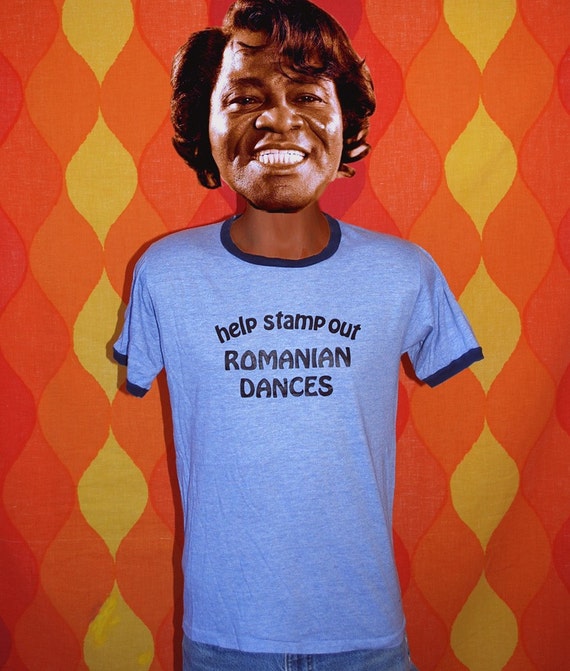
There is actually a T-shirt you can buy that reads "Help Stamp Out Romanian Dances."

http://ny-image0.etsy.com/il_570xN.205531732.jpg

The people of Dobrudja, in northeast Bulgaria, incorporate a lot of stamping in their dances. Dances often cross borders, and although they take on different nationalities, those from neighboring regions often have something in common. This one is Sitna Zborenka.


Stamping dances are common to other parts of the Balkans, because the Vlachs got around, and wherever they settled they took the stamping dances with them. This one from Serbia is Vlashki Sat.


For more on how dances change from country to country read:

http://katleyplanetbg.blogspot.com/2010/09/travels-of-pajdusko-horo.html

If you like northern Bulgarian dances with lots of stamping, this post is for you.

http://katleyplanetbg.blogspot.com/2010/10/river-of-many-names-part-2-danube-in.html

Creative Commons License
This work is licensed under a Creative Commons Attribution-Noncommercial-No Derivative Works 3.0 United States License.

Saturday, June 18, 2011

Bulgarian Folk Songs with a Hungarian Accent....

One of my longtime friends, a folklore fan born in Budapest, Hungary, visits the Universe of YouTube when she has a few minutes to spare. She is an avid dancer, like myself, and we have gone to dances and festivals together many times over the years.

She enjoys music from the Balkans and knows that I'm fond of unusual folklore videos. One of the signs of a good friendship is that she knows my taste in music, and she has emailed me some really good stuff. Judging by what she's sent, the Hungarians admire Bulgarian folk music.

The first song is Young Girl at the Spinning House, and the rhythm here is 7/8 (apple-apple-pineapple). This is the rhythm for rachenitsa, the national dance of Bulgaria.

The performer is Szilvia Bognar, who sings this delightful and lively song in Hungarian. Note: Hungarians use the last name first.  This article on Wikidpedia explains why.

http://en.wikipedia.org/wiki/Hungarian_names


This high energy song Meggyujtom a Pipam (I light my pipe), is performed by the Hungarian group Besh O Drom. Those who are familiar with Bulgarian folk music will recognize it as the dance Graovsko Horo. It has English subtitles, so I didn't have to resort to Google Translate :)


Bulgarian folklore fans will also recognize the next song, the Hungarian version of Dilmano Dilbero. It has been renamed Falcon Song and it's based on a poem by László Nagy. Márta Sebestyén is a well known performer of Hungarian folk music, and here she's accompanied by Szilvia Bognár, Palya Beáta, and the Sebő Ensemble.


The original song, performed by the Mystery of Bulgarian Voices, is the one most people know.


If you enjoyed this you may also like Bulgarian Folkore Travels Abroad and Modern Versions of Traditional Bulgarian Folk Songs.

http://katleyplanetbg.blogspot.com/2010/06/bulgarian-folk-music-travels-abroad.html

http://katleyplanetbg.blogspot.com/2011/06/modern-versions-of-traditional.html

For more on Bulgarian rachenitsa read:

http://katleyplanetbg.blogspot.com/2010/07/flavors-of-bulgarian-rachenitsa.html

Creative Commons License
This work is licensed under a Creative Commons Attribution-Noncommercial-No Derivative Works 3.0 United States License.

Sunday, June 12, 2011

Some Balkan Dances with Very Strange Names

Today's post is about Balkan dances with strange sounding names.

When your native language is English, there are bound to be some foreign words that look and sound downright odd. Balkan dances, for the most part, have Slavic names (except for Romania, Albania, and Greece).

The Romanian language is based on Latin, although even with my background in Spanish, I can only understand a few words, most of them pertaining to dances. It has strayed that far from its original Latin roots.

The Albanian language is even stranger. It may have had Greek and Latin roots, but it incorporated other regional dialects. What is weird is their fondness for umlauts, (like the Germans). For example, this is the world for nose (hundë).

As for Greek, it's one of those languages I can't read because of the alphabet. Many English words have roots in Greek, so it's a language that is very useful, especially to scholars.

The first video is a fun and very macho dance from Serbia. Some people call it the "ooh-ahh" dance. The actual name for it is Sestorka. (pronounced shes-tur-ka). This dance is usually done with a belt hold, which makes it more difficult, but the Chinese group here uses a hand hold instead.


Macedonian words, when transliterated into English, become an alphabet soup full of consonants. Even though this dance is almost unpronounceable (by English speakers, anyway), it's energetic and fun to do. The name is Crnagorka.


This is a rachenitsa from Dobrudja, a region in Northeast Bulgaria, with a very odd name. A leader at one of the dances told me that this dance was connected with planting peas, and although it's slow compared to Sestorka, it's a lot tricker than it looks. Can you say "sej sej bop?"


For more on the rachenitsa, the national dance of Bulgaria, read

http://katleyplanetbg.blogspot.com/2010/07/flavors-of-bulgarian-rachenitsa.html

This is a very beautiful, slow and easy dance from Albania, Cobankat. The pronounciation is almost like Italian (cho-ban-kat). Albania is a part of the world that most people hear and know very little about. The music has a very haunting and beautiful sound. The song is about women weaving blankets for the men, who are off fighting in the mountains during the dead of winter.


If you enjoyed this, you may like:

http://katleyplanetbg.blogspot.com/2010/09/travels-of-pajdusko-horo.html

Creative Commons License
This work is licensed under a Creative Commons Attribution-Noncommercial-No Derivative Works 3.0 United States License.

Saturday, June 4, 2011

Modern Versions of Traditional Bulgarian Folk Songs

The theme for today's post is modern versions of traditional Bulgarian folk songs.

Some of these modern interpretations are quite interesting, creative and unusual. The first song, Katerino Mome, sung by Tatiana Sarbinska, is familiar to those in the international folk dance community. The dance for this is Arap.


The lyrics and translation can be found here:
http://www.dunav.org.il/lyrics/katerino_mome.html

I first heard Katerino Mome performed by Desislava on the Bulgarian National Radio several years ago. I didn't care for this performance at first, because I was used to the traditional version. After listening to this a few times, I found that I liked Desislava's dynamic and passionate interpretation of Katerino Mome as much as the original.


The next song is Izgryala e Mesechinka, traditionally performed without background music (a capella) by a women's choral group. In this video, the ladies are accompanied by a drum, which does not detract at all from their beautiful voices. The dance for this song is a rachenitsa. I couldn't find a link to the lyrics, but it's essentially a song about the full moon rising, big, beautiful and orange, while a girl picks flowers in the garden.


Another version of Izgryala e Mesechinka, this time with one female singer accompanied by five men. Four of them play traditional folk instruments (gadulka, accordion, kaval, and tambura). One of them keeps time on what looks like a metal cup, and the other plays guitar. The non-traditional instruments and the solo female give this song a unique and modern intepretation that is delightful to listen to!


The next song is a traditional version of Dunave, Beli Dunave. It is a song about the Danube, River of Many Names. Despite its popularity on YouTube, I couldn't find the lyrics or a translation. The rhythm for this is 5/8, and the dance is Pajduško Horo.


This is the modern version which was probably played at clubs all over Bulgaria. What really makes it unusual the techno music accompanied by a gaida (bagpipe). This is definitely an unusual take on a traditional song and took some getting used to, although I like it a lot now. If you listen to it more than once or twice it will take up residence in your head and stay with you all day. It's a very catchy tune.


If you like variations on a theme, check out this post.

http://katleyplanetbg.blogspot.com/2011/03/family-resemblance-theme-and-variations.html

Creative Commons License
This work is licensed under a Creative Commons Attribution-Noncommercial-No Derivative Works 3.0 United States License.