I would like a wine. The purpose of the wine is to get me drunk. A bad wine will get me as drunk as a good wine. I would like the good wine. And since the result is the same no matter which wine I drink, I’d like to pay the bad wine price.
Steve Martin
Today's post is about songs that tell a story.
Video #1 is a dance song from North Macedonia that tells the story about a rabbit on his way to Salonika to get married. He had several adventures on the way, and almost got killed by the hunters and their dogs. It has a surprise ending!
The dancers in Video #1 and Video #2 are from Vienna, Austria.
Video #2 isSadi Moma, a song from the Pirin region of Bulgaria. It describes a young woman who planted a grape vine. The vine became really big and the grapes from it produced barrels of wine and rakia so strong the soldier who drank it was out of commission for a week. He must have had one hell of a hangover when he finally woke up. Was it good wine or bad wine?
Sadi Moma also underwent a second incarnation as the Free Software Song. It wasn't the same guy who had the hangover after drinking the wine and rakia.
Video #4 is the Dance of Zalongo (you can read the story and the translation of the song here.) This was a really dramatic event that occurred in Greece in 1815. It's similar to the story of Masada, where the inhabitants chose mass suicide over slavery.
The music is in 7/8 (pineapple-apple-apple). There is no dancing in the video, although there is a picture of women in Greek folk costumes, as well as a statue that depicts women dancing to their deaths on the rocks below.
I like to see myself as a bridge builder, that is me building bridges between people, between races, between cultures, between politics, trying to find common ground.
T.D. Jakes
This week's post will be short, as there were two great ethnic events in the area this past weekend. The first was the Springfield Massachusetts Glendi, a three-day festival of Greek music, dance, and food. Too bad I forgot to take a picture of the moussaka before I ate it. It was delicious.
Once my hunger was sated, I took a video of the dancers. I was traveling light and used my phone instead of the camera to take the video, so the sound quality wasn't great. You can hear it if you turn up the speakers to the highest setting.
Last year's video was much better because I used the camera. I was able to zoom in on the dancers performing a Pentozaliand here you can REALLY hear the music.
There was also a Bulgarian event that I went to last Friday, and I remembered to bring the camera. Everyone got up and danced to Bulgarika, despite the fact that the Masonic Hall was very hot and sticky, and the only cooling devices were two large fans (no air conditioning.) Summer decided to come to New England in September. It was running late this year.
I will write more on Bulgarika in a future post. Bulgarika is currently on tour in the United States. They are a four person ensemble; two live in New York City and two traveled here from Bulgaria.
The dance is Sadi Moma, with vocalsby Donka Koleva.
In another incarnation, Sadi Moma became the Free Software Song. By the way, the time signature is 7/8, very common in Bulgarian folk music, and in this song the rhythm is pineapple-apple-apple.
I like to think dance is an international language that all people can appreciate. Paul Taylor
Today's post will feature popular Balkan folk dances performed by informal groups from around the world. Folk dancing is lots of fun and has numerous benefits: you make new friends, it activates new pathways in the brain and it provides plenty of aerobic exercise. Nothing like spending an evening of getting high on endorphins!
The first group is from the United States, KoloKoalition. They have many videos posted on the Universe of YouTube; their specialty is intermediate and advanced line dances from the Balkans. This cute little number is Prekid Kolo from Serbia accompanied by live music. Dancing to live music can be a little tricky, since the musicians will play something slightly different than the recordings.
You will recognize this "Bonding Folkdance Class" from China, especially if you read The Alien Diaries regularly. This dance is Berovka, from the Republic of Macedonia.
The Dunav group from Israel has been featured on this blog numerous times. Joc Batrinesc, a graceful dance from Romania, is popular with my dance group, as well. We do it almost every week.
Vienna may be the land of the waltz, but once in a while they'll try something different, like this dance from Bulgaria, Sadi Moma. The Tanzgruppe Bäckerstrasse also has a social networking site for dancers, Dancilla, which is bilingual (German/English). It features a wide variety of dances from all over the world. If you like folk dances from Germany and Austria, they're the place to visit.
Balkan music has its fans in Canada. The Burnaby International Folk Dancers of Burnaby, British Columbia do a dance from Albania, Valle e Dardhes.
The Always on Sunday Group dances in Wethersfield, Connecticut, and I go to their dances from time to time because I love their live music events. This video features Kabile, a band from the Thracian region of Bulgaria. I recorded a few numbers from that evening, the rest of the night I spent dancing.
I don't know the name of this piece, but the dance to it is a lesnoto, and it's some of the most beautiful music I've ever heard on this planet.
If you enjoyed this you may also like Folk Ensembles Named After Dances
Part of the experience of visiting a foreign country has to do with the food and drink and the fun things you get to do while mingling with the natives. You can get into the heart and soul of a culture and it's a great way to make new friends.
Today's post is about folk songs and booze. In the Balkans booze is big, and there are many different alcoholic beverages: Greek Ouzo, Bulgarian Rakia, and Serbian Slivovitz to name a few.
Then there is the ubiquitious fruit of the vine. Wine is one of the oldest drinks known to man. When the ancient peoples discovered wine it opened up new horizons, especially when primitive societies found that grape juice not only tasted good after it was fermented, but that it made people happy and sociable. A few drunken individuals entertained the rest of the group by doing really stupid things, this became known as "partying."
An enterprising individual found that he could make the wine stronger by distilling it into brandy, from that, rakia was born. And a very clever woman discovered that by planting a few grape vines, she could create a beverage that could knock a man out. He drank the wine, the rakia and the horse!
Can you count backwards from ten after a few shots of Slivovitz (the national drink of Serbia)? Niška Banja is a drinking song from Serbia, and that is exactly what they do after a day spent at the thermal baths in town; sing and drink slivovitz. Slivovitz is plum brandy and its taste and effects are nothing like prune juice :) I tried some on an freezing cold day in Germany, it warmed up those insides quite a bit.
Here are the lyrics in case you want to sing along. Make sure to pick up some slivovitz at the local liquor store first. If you have a Serbian neighbor who makes the stuff, it's probably much better than anything you can buy.
Unfortunately too much of a good thing has its drawbacks. Poor Gino! Don't drink the wine! Now he has an enormous headache. Or is he in pain from the loss of the one he loves?
The dance to the previous video was a lesnoto (galloping-apple-apple), which is a rhythm common in Bulgarian and Macedonian dances.
When I die, drink some red wine and break the glasses. Now that would be a fitting tribute to a life well lived. This beautiful and poignant folk song, Ako Umram il Zaginem, is from Macedonia. This song is also in lesnoto rhythm.
Here are the lyrics (and the music score) in case you want to sing along. We often do Ako Umram as a sing-along at the Sunday night dances, the description, in Bulgarian, for singing while dancing is called "horo na pesen."
If you love Balkan music and dance you have come to the right place! The Alien Diaries began in February 2010 and is updated at least twice a month.
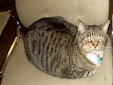
This blog is dedicated to the memory of my cat Fatso (see avatar), who passed away on April 9, 2011 from congestive heart failure. He was the inspiration for several of my early posts.
Don't forget to check out my second blog, Light and Shadow, for some humor, satire, photos and poetry!